
Going beyond the Basics, the Advanced tab is where you can configure more complex options and functionality to decide how you want MailPoet to work behind the scenes.

1. Bounce email address
MailPoet will redirect bounced messages to this email address. Read more about bounce messages.
For reasons explained in the link above, if you are sending with your own website/web server, we highly suggest you use an email address from the same domain as your website.
2. Newsletter task scheduler (cron)
This option allows you to choose the method by which MailPoet will manage your sending queue. Read more about this.
3. Roles and capabilities
This isn’t an option rather it’s a recommendation that if you wish to fine tune user permission for MailPoet you can do so using the Members plugin.
4. Engagement analytics tracking
Want MailPoet to collect statistics for you, such as how many newsletters were opened, links that were clicked or the number of subscriptions canceled? If so, you should definitely use this option. You can read more about Details Statistics here.
Why shouldn’t you use this option?
- You are using a third-party service to send your newsletters and this service already tracks your links
- You are experiencing redirection issues with your MailPoet links. Sometimes, disabling link tracking will fix this issue.
5. Human and machine opens
This is a display setting. Machine opens are still counted separately, but you can choose to combine them in your stats.
6. Send all site’s emails with…
If you want to make use of MailPoet Sending Service’s improved deliverability for your non-MailPoet emails as well, you can enable this option to send all of your site’s “transactional” emails via the sending method you’ve configured for MailPoet. This would be emails such as password resets, new registrations, WooCommerce Order emails, and so on. You can read more about this in our guide here.
7. Recalculate Subscriber Scores
MailPoet will automatically calculate and update Subscriber scores as events like Opens and Clicks occur. However if scores don’t appear to be accurate, you can force a recalculation at any time by running this tool.
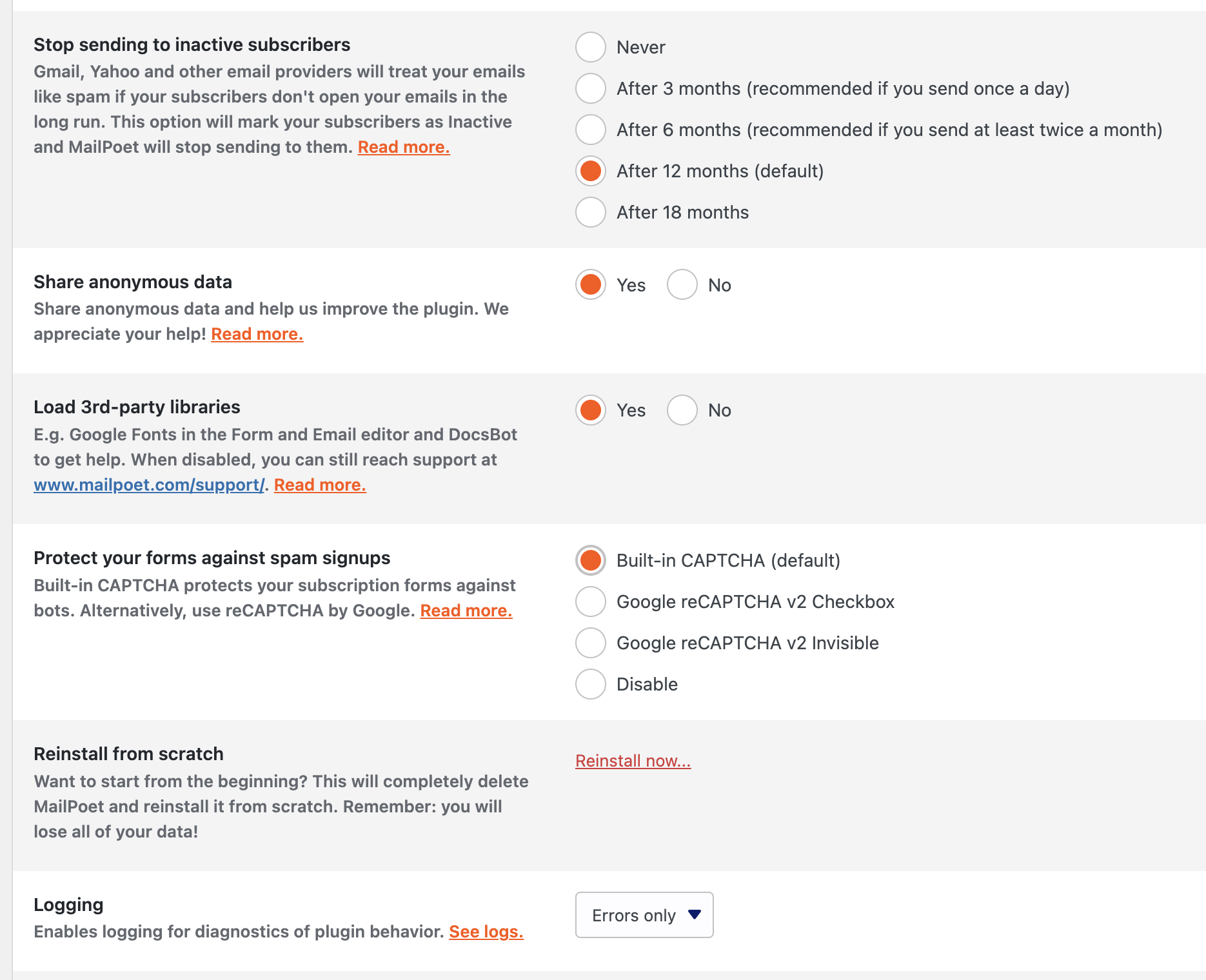
8. Stop Sending to Inactive Subscribers
This option allows you to set how quickly a subscriber should be considered inactive after going X number of months without opening or clicking a newsletter. While this feature can be turned off, we highly recommend leaving it enabled. Read more about this option.
9. Sending status data retention
Every time MailPoet sends an email, it keeps a per-subscriber row recording who has been queued, sent, or failed. Over time these rows pile up in the scheduled_task_subscribers table and can grow into millions of entries on busy sites, slowing down database backups and admin pages.
This setting lets you choose how long MailPoet should keep that per-subscriber sending data after a send is complete:
- Never – keep everything indefinitely (default for existing installations).
- After 1 month
- After 2 months
- After 3 months
- After 6 months
When the retention window is reached, MailPoet automatically deletes the per-subscriber rows in the background. The newsletter itself, its subject, its statistics totals (opens, clicks, unsubscribes), and its “View in browser” link are not affected.
What does change after the cleanup? The Sending Status page of an old newsletter no longer shows the per-subscriber list (who was sent, who failed, etc.) – an information notice appears instead with a link back to this setting. Aggregate statistics on the newsletter’s Stats page are unchanged.

Existing installations default to Never – nothing is deleted unless you opt in. New installations also start at Never and ask you to choose.
10. Purge rendered email body from old sends
When MailPoet sends a newsletter, it stores the fully rendered HTML body in the database so it can be used to retry failed sends and to power the “View in browser” link. Each rendered body can be tens or hundreds of kilobytes, and the mailpoet_sending_queues table grows accordingly.
This setting lets you tell MailPoet to clear the stored rendered body for sends that have completed and are older than the chosen window:
- 7 days
- 30 days (default)
- 90 days
- 1 year
- Never – keep all rendered bodies forever.
Only the rendered HTML is purged. The newsletter, its subject, its statistics, and its sending history are untouched. The “View in browser” link continues to work even after the body is purged – MailPoet re-renders the email on the fly from the original template.

Choose a longer window (or Never) if you frequently need to retry old sends or if you rely on the exact rendered HTML being preserved. The default of 30 days is a good balance for most sites.
11. Collect subscribers’ time zones
When this option is enabled, MailPoet automatically detects and saves the browser time zone of visitors who subscribe through your MailPoet forms. No extra steps are needed from the subscriber.
This data can be used to send newsletters based on each subscriber’s local time, helping you deliver emails at the most effective hour regardless of where your audience is located.
This setting is enabled by default. To disable it, select No and click Save settings.

Time zone data is only collected from MailPoet form submissions. Subscribers added through imports, WooCommerce, or other methods will not have time zone information unless they later subscribe through a form.
12. Share anonymous data
By sharing your data anonymously with us, you can help the MailPoet team understand how people use MailPoet and what sort of features they like (and don’t like.) Find out more.
13. Load 3rd-party libraries
Having this enabled will allow MailPoet to load code libraries for Google Fonts to be used in the Form Editor, and for our HelpScout support system to load the built-in support features in your wp-admin dashboard (the icon in the bottom-right corner while viewing MailPoet pages in your administrator dashboard).
14. Protect your forms against spam
This option allows you to enable MailPoet’s built-in CAPTCHA or Google reCAPTCHA to protect your MailPoet signup forms from automated bots. Read more about this option.
15. Reinstall from scratch
Wait a minute! Be very careful with this option. If you activate it, it will completely remove all your existing newsletters, subscribers, lists and settings from your MailPoet. You will not be able to recover them. If you need to use this option, be sure to first back up your database and export your newsletters and subscribers.
16. Logging
This option allows you to enable varying levels of logging, either all, errors only or no logging at all. Click the See logs link to view available logs.
You must be logged in to post a comment.