
When creating an Automation, choosing a trigger is the first step. Your workflow will hinge upon which trigger you decide to use, whether it is an abandoned cart or an order status change in your WooCommerce store. Each trigger is an event that may occur and lets you automate specific actions accordingly.
Here, you can find a comprehensive list of available triggers, separated by type.
Users
WordPress User Registers
Triggers when a user registers a user account on the site through your website’s registration form.
Note that if Sign Up Confirmation is enabled, the user will only enter the automation once they confirm their subscription and have their status changed from Unconfirmed to Subscribed.
The trigger settings on the right sidebar allow you to set one or more user roles. This gives you the power to set an action like Send Email with personalized content for each user role.

Comment Posted
Fires when a user posts a comment on your website. From the trigger settings, you can filter by comment status (e.g., approved, pending), post type (e.g., posts, pages), specific posts, and taxonomy terms (e.g., categories, tags). This gives you precise control over which comments trigger the automation.

WordPress User Role Changed
Triggers when a WordPress user’s role is changed, added, or removed. From the trigger settings, you can filter by the previous role and the new role. Both default to “any,” so you can target specific role transitions (e.g., from Subscriber to Customer) or any role change.
Subscribers
Someone Subscribes
Triggers when a user subscribes to your list(s).
Note that if Sign Up Confirmation is enabled, the user will only enter the automation once they confirm their subscription and have their status changed from UnconfirmedtoSubscribed.
The trigger settings on the right sidebar allow you to set one or more lists. This gives you the power to set an action like Add tag to add different tags to subscribers based on the list they are joining.

Tag added to Subscriber
This trigger allows you to have a subscriber enter the automation by adding a tag to them. You can select which Tag(s) being added will fire the trigger in the settings in the right sidebar.
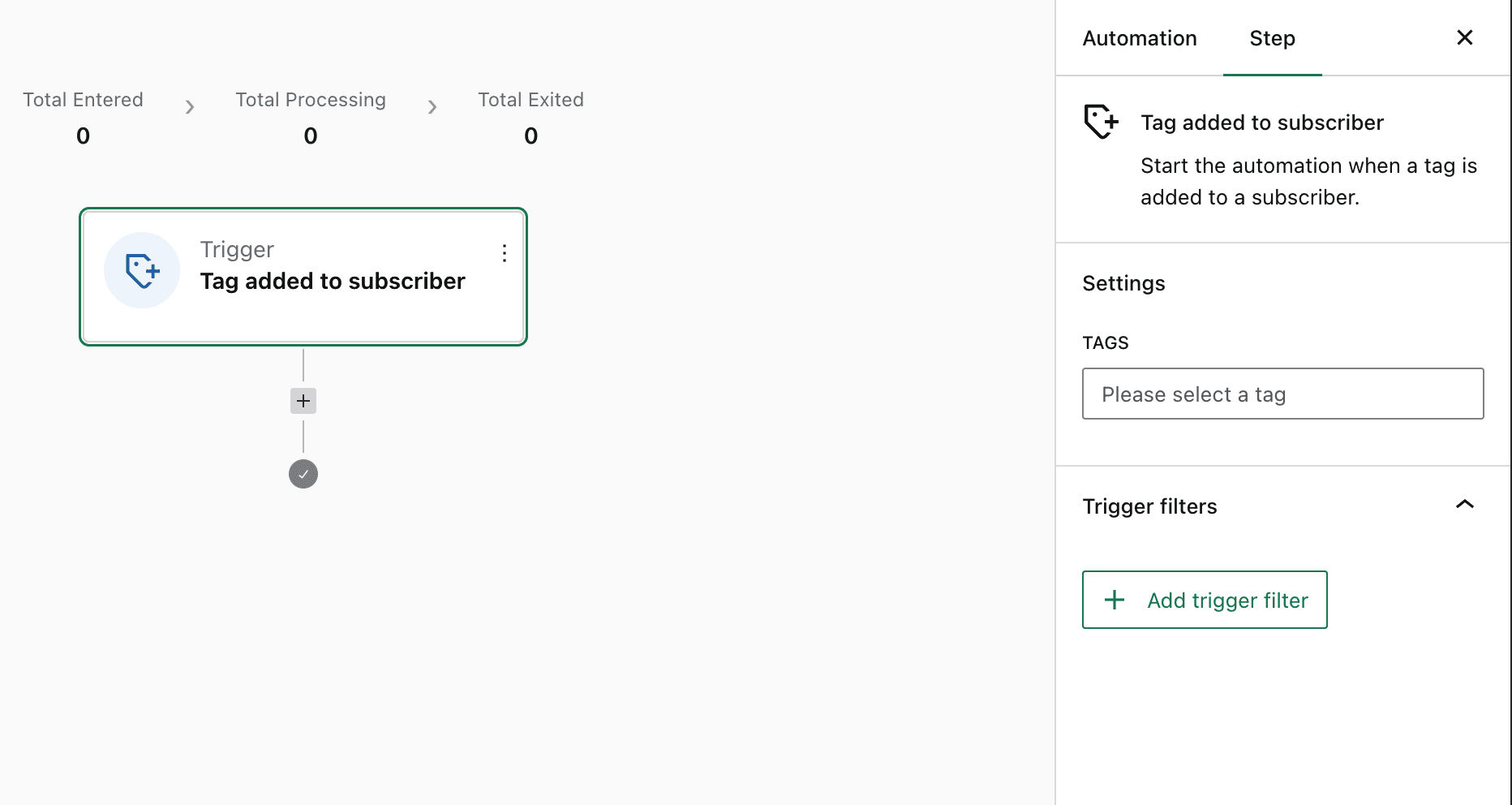
Note that adding tags to subscribers in bulk (via admin bulk actions or CSV import) will NOT trigger the automation. You need to manually edit each subscriber and add the tag individually for the automation to work.
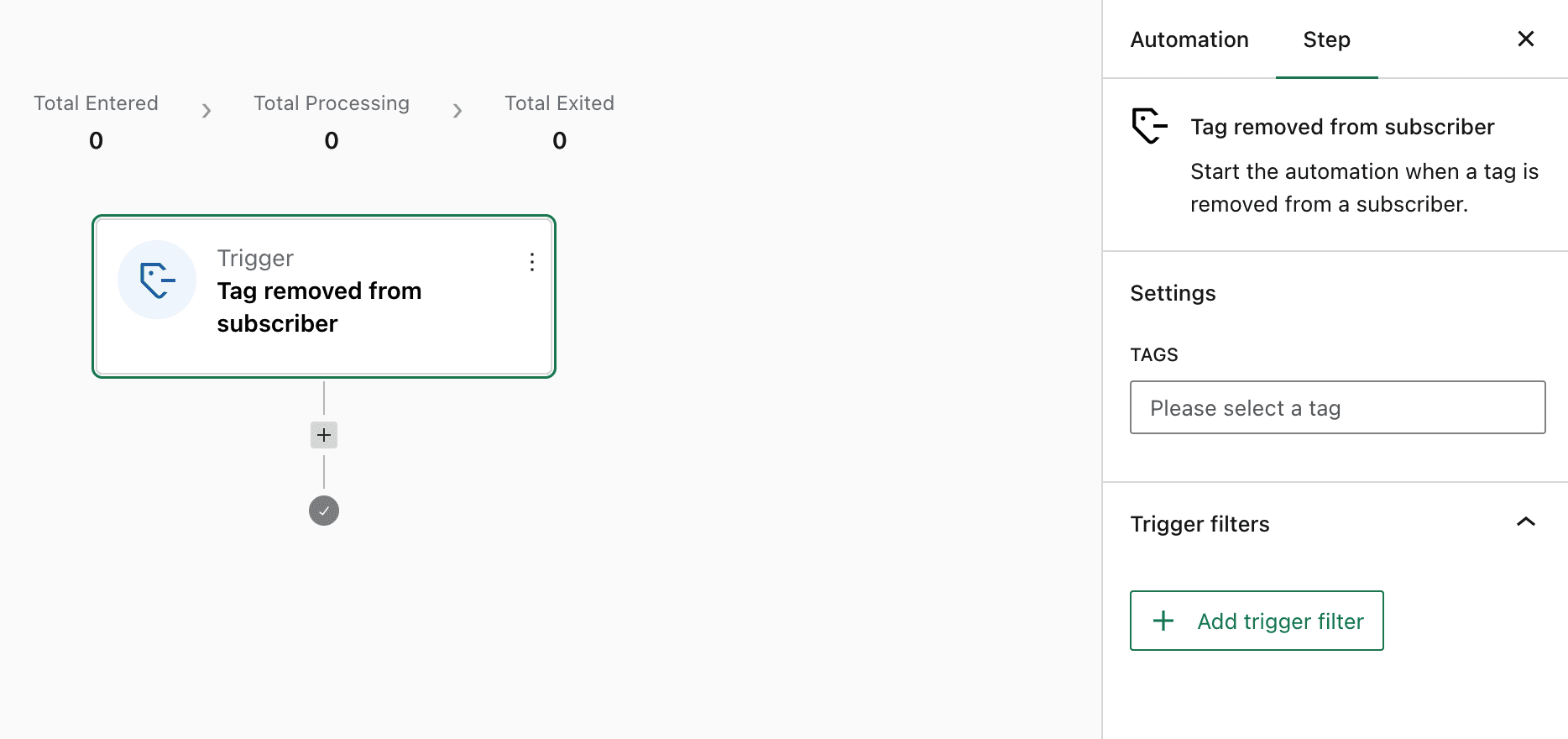
Tag Removed from Subscriber
This trigger allows you to have a subscriber enter the automation by removing a previously added tag. You can select which Tag(s) being removed from the subscriber will fire the trigger using the settings in the right sidebar.
Email Link Clicked
Triggers when a subscriber clicks on a link in a specific newsletter. You can choose which newsletter the trigger will target from the trigger settings on the right sidebar, and then select the specific link(s). You can also set the operator to control whether the subscriber needs to click any, all, or none of the selected links.

Please note that it’s not currently possible to target links in Automation emails. On the same note, branching your automation based on clicked links in emails earlier in the automation is not currently possible. There’s an open request to add that functionality on our feedback board here. If this is a feature you would find useful, please add your vote there to show your support for the request.
Email Subscriber Unsubscribed
(Requires paid MailPoet plan and MailPoet Premium plugin)
Triggers when a subscriber unsubscribes from one of your lists. This is useful for sending a follow-up email, removing tags, or starting a win-back sequence when someone leaves your list.
From the trigger settings, you can select one or more lists. The automation will only fire when a subscriber unsubscribes from one of the selected lists. If no list is selected, the trigger fires for any list unsubscription.

Birthday
(Requires paid MailPoet plan and MailPoet Premium plugin)
A recurring time-based trigger that fires every year on the day matching a subscriber’s date custom field (for example, their birthday). From the trigger settings, you can configure:
- Date field – the year/month/day custom field that holds the birthday.
- Timing – send before, on, or after the date, with a configurable number of days offset.
- Send time – the hour of the day (0–23) when the automation fires, in the site’s timezone.

See the dedicated Birthday Emails guide for the full setup, including the date custom field and the formatted-date shortcode.
Orders
Emails sent by triggers related to Orders are considered transactional emails, so they are fired whether the customer is subscribed to your newsletters or not as long as the automation is set to send an email immediately following the order status change (without a Delay action).
Filtering by Product Type
All order-related triggers include a product type filter in the trigger settings. This allows you to restrict the trigger to orders that contain products of a specific type, such as simple products, variable products, or subscription products.
The following product types from WooCommerce are always available:
- Simple
- Variable
- Grouped
- External/Affiliate
Additional product types appear automatically when their respective plugins are active on your site. For example, if WooCommerce Subscriptions is installed, the Subscription type becomes available. The same applies for Booking (WooCommerce Bookings), Bundle (WooCommerce Product Bundles), and Composite (WooCommerce Composite Products).
This is useful for creating targeted automations. For instance, you could send subscription onboarding instructions only for orders that contain subscription products, or send booking-specific details only for orders with booking products.
Order Status Change
Triggers when an order’s status changes. In the trigger settings, you can set it to fire at any status change or at specific status changes (e.g., from Processing to Complete).

Order Paid
(Requires paid MailPoet plan and MailPoet Premium plugin)
Triggers when a WooCommerce order is paid. This trigger fires when payment is completed for an order, covering both the WooCommerce payment-complete event and transitions from an unpaid status to a paid status.
Unlike Order Created, which fires when the order record is written to the database (often before payment is confirmed), and Order Status Changed, which fires on every status transition, Order Paid fires exactly once, only after payment succeeds. This makes it the right choice for post-purchase workflows that depend on confirmed payment, such as thank-you emails, digital product onboarding sequences, or fulfillment notifications.
WooCommerce can sometimes emit multiple payment events for the same order (for example, both a payment-complete event and a paid-status transition). MailPoet automatically checks whether the automation has already run for that order and prevents duplicate runs.
Like other order-related triggers, emails sent immediately after Order Paid (without a Delay action) are treated as transactional and are sent to all customers regardless of subscription status. Adding a Delay action before the Send Email action changes the email to marketing. You can read more about transactional and marketing emails here.
Order Completed
Fires when an order status changes to Completed. It’s similar to the above but more straightforward.
Order Cancelled
Triggers when an order is cancelled.
Order Created
Triggers when a new order is created (i.e. as soon as a customer places an order).
Order Note Added
Starts when a note is added to an order. From the trigger settings, you can filter by note type (all notes, customer notes, or private notes) and by note content (only trigger when the note contains specific text).
Customers
Customer Win-back
(Requires paid MailPoet plan and MailPoet Premium plugin)
A scheduled trigger for re-engaging inactive WooCommerce customers. MailPoet periodically scans your customer base and starts the automation for customers who have not placed an order within a specified number of days.
From the trigger settings, you can configure:
- Days since last purchase – the number of days since the customer’s last completed order. Customers who have not placed an order within this period will enter the automation.
The automation includes the customer’s data, WordPress user profile, and their last completed order as context, allowing you to personalize the win-back email with relevant details.
You can use the automation-level “Run automation once per subscriber” setting to prevent the same customer from entering the win-back automation more than once.
Product Purchased
Triggers when a customer buys a product. From the settings, you can select specific products and the order status that should fire the trigger.

Product Purchased (Tag)
Triggers when a customer buys a product with a specific product tag. From the settings, you can select the tag(s) and the order status that should fire the trigger.

Product Purchased (Category)
Triggers when a customer buys a product from a specific product category. From the settings, you can select the category(s) and the order status that should fire the trigger.
User Abandons Cart
Triggers when a subscriber leaves a product in the cart without completing their purchase. You can set the wait time (in minutes) that determines when a cart is considered “abandoned.” The default is 30 minutes.

Emails sent by this trigger are considered transactional, so they will fire whether the customer is subscribed to your newsletters or not as long as the automation is set to send an email immediately following the trigger (without a Delay action).
Also, note that MailPoet needs to be aware of the visitor’s email address, so they will need to either 1) be logged into an account, or 2) have a cookie set in their browser that allows the plugin to identify the subscriber (by clicking a link in an email received from MailPoet).
Review Posted
Triggers when a customer leaves a product review on your website. You can find several customization options in the settings. It’s possible to set the review status and the rating that should trigger the automation, as well as select products, categories, and tags.

Customer’s Saved Card Expires
(Requires paid MailPoet plan, MailPoet Premium plugin, and WooCommerce)
A scheduled trigger that runs a set number of days before a customer’s saved credit or debit card expires. This is useful for reminding customers to update their payment method before it becomes invalid, helping reduce failed payments and subscription churn.
Cards expire on the last calendar day of their expiry month (for example, a card with a 07/2026 expiry date expires on July 31, 2026).
From the trigger settings, you can configure:
- Days before expiry – the number of days before the card’s expiration date when the automation should fire. Accepts a value between 1 and 365. The default is 7 days.
- Send time – the hour of the day (0–23) when the automation runs, in your site’s timezone. The default is midnight (0:00).

The automation does not run immediately after it is activated. It runs daily in the background at the hour you set in the Send time field. If no send time is configured, it defaults to midnight.
Important: Not every payment gateway is compatible with this trigger. It supports gateways that use WooCommerce’s native token storage method. The following gateways are known to be supported:
- WooPayments
- WooCommerce Stripe
- Simplify Commerce (included with WooCommerce)
The following gateways are known to not be supported:
If you use a different payment gateway, contact the developer of your gateway plugin to ask whether it uses WooCommerce’s native payment token system.
The automation includes the saved card’s data as context, allowing you to personalize your email with details such as the card type, last four digits, and expiry date. The customer must be a registered WordPress user with a linked MailPoet subscriber profile for the trigger to fire.
MailPoet automatically prevents duplicate automation runs for the same card and automation. See the dedicated How to Send Saved Card Expiry Reminders guide for full setup instructions and example workflows.
WooCommerce Subscriptions
(Requires paid MailPoet plan and MailPoet Premium plugin)
Emails sent by triggers related to Woo Subscriptions are considered transactional emails, so they are fired whether the customer is subscribed to your newsletters or not as long as the automation is set to send an email immediately following the trigger (without a Delay action).
Woo Subscriptions Status Changed
Triggers when subscriptions’ status changes. In the trigger settings, you can set it to fire at any status change or at specific status changes (e.g., from Active to On Hold).

Woo Subscription Started
Triggers when a customer’s subscription period starts.
Woo Subscription Trial Started
Triggers when a subscription trial period starts.
Woo Subscription Trial Ended
Triggers when a subscription trial period ends.
Woo Subscription Renewed
Triggers when a subscription gets renewed.
Woo Subscription Payment Failed
Triggers when the payment for a new subscription purchase or a renewal fails.
Woo Subscription Expired
Triggers when a subscription expires.
WooCommerce Bookings
(Requires paid MailPoet plan and MailPoet Premium plugin)
Emails sent by triggers related to Woo Bookings are considered transactional emails, so they are fired whether the customer is subscribed to your newsletters or not as long as the automation is set to send an email immediately following the trigger (without a Delay action).
Booking Created
Starts when a new booking is created by a customer or store staff. The trigger fires when a booking transitions from a draft status (such as in-cart or was-in-cart) to a confirmed status, ensuring it only triggers once per booking.
Booking Status Changed
Starts when a booking changes to a selected status. In the trigger settings, you can set it to fire at any status change or at specific status changes (e.g., from Active to On Hold).

Booking Starts
A time-based trigger that fires before or after a booking’s start date. From the trigger settings, you can configure:
- Timing – choose whether to trigger before or after the booking starts.
- Time offset – set a value between 1 and 365 in minutes, hours, or days (e.g., “2 hours before the booking starts”).
- Booking statuses – select which booking statuses should match (at least one is required).
When an automation using this trigger is activated, MailPoet automatically scans existing future bookings and schedules them. If a booking’s start date is updated, the trigger is automatically rescheduled.
Custom Trigger
This trigger enables developers to create a customized trigger that responds to specific hooks in WordPress. More details about this trigger can be found here.
You must be logged in to post a comment.